
Municipal personal alarm vs private – what is the difference?
A local authority personal alarm requires a needs assessment, only works indoors, and alerts a care alarm centre. A private personal alarm can be ordered directly, works outdoors, and alerts your relatives immediately – with no waiting time and no application.
What is a local authority personal alarm?
A local authority personal alarm is an assistive device provided following a formal needs assessment, usually connected to a care alarm centre or home care staff. The alarm is subsidised by the local authority and typically costs the equivalent of £15–40/month.
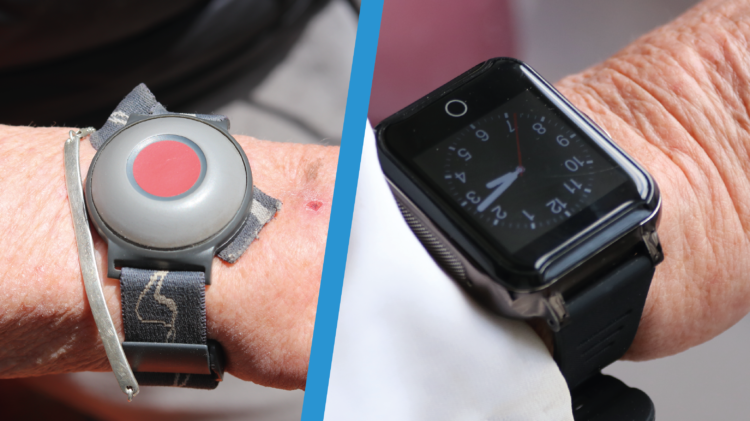
The local authority alarm is designed to work in the home – not outdoors. It is a traditional alarm button worn as a pendant or wristband which, when activated, connects to the council’s alarm centre.
Limitations of the local authority alarm:
- Requires a needs assessment – the process takes time and is not always approved
- Works indoors only – you are unprotected the moment you leave home
- No GPS positioning – relatives cannot see where you are
- No automatic fall detection – you must be able to press the button yourself
- Alerts a care alarm centre, not your relatives directly
- Often requires that home care has a key to your home
What is a private personal alarm?
A personal alarm from Sensorem requires no application, no needs assessment, and no key handover. It is ordered directly online and delivered within three working days.
Sensorem’s personal alarm is designed as a discreet smart watch – nothing on the outside reveals that it is an alarm. It works outdoors, on holiday, and on the go, alerting your relatives directly via the watch’s built-in speakerphone.
Local authority vs private personal alarm – comparison
| Local authority alarm | Sensorem’s personal alarm | |
|---|---|---|
| Needs assessment required | Yes | No |
| Delivery time | Weeks or months | 3 working days |
| Works outdoors | No | Yes |
| GPS positioning | No | Yes |
| Automatic fall detection | No | Yes |
| Alerts | Care alarm centre | Relatives directly |
| Two-way communication | Sometimes | Always |
| Medication reminders | No | Yes |
| Design | Traditional pendant alarm | Discreet smart watch |
| Key handover required | Often yes | No |
| Cost | £15–40/month (subsidised) | From €21.25/month |
Why do many people choose a private alternative?
1. No waiting time The local authority needs assessment can take weeks. The need for security often arises acutely – after a fall accident, a stroke, or a dementia diagnosis. With a private alarm, you can have security in place within three days.
2. Works outdoors Almost 60% of fall accidents happen outdoors. The local authority alarm only covers the home – Sensorem’s alarm works everywhere there is a mobile network. Read more about a personal alarm that works outdoors.
3. Alerts relatives directly The local authority alarm connects to a care alarm centre which then contacts home care. Sensorem’s alarm calls relatives directly in a predetermined order – faster and more personal.
4. Discreet design The local authority alarm is clearly identifiable as an alarm device. Sensorem’s alarm looks like a regular smart watch – nothing for bystanders to notice. Read more about the watch’s design.
5. No key handover Many people find it uncomfortable that home care should have a key to their home. With a private alarm, it is your relatives who handle the situation – not council staff.
Can you have both?
Yes. Many people choose to keep the local authority alarm indoors and add Sensorem’s alarm for outdoor use. The council alarm covers the home; Sensorem’s alarm covers the rest of the day – the walk, the garden, and the trip.
It is also a common choice for relatives of people with dementia who tend to go out alone.
When should you seek help?
Contact your local council’s social services if you want to apply for a local authority personal alarm. Call 999 in emergencies. Contact your GP if you are unsure which support is best for you.
Read more: The personal alarm – Automatic fall alarm – Works outdoors – Dementia tracker
Personal alarm for the elderly with automatic fall detection
Sensorem’s personal alarm is an example of a technical aid specially developed for people with dementia. The personal alarm works outdoors and has built-in GPS positioning so that relatives can see the user’s position on a map in the Sensorem app. Relatives are automatically called by the personal alarm (two-way communication) if the user leaves a predetermined geographical area. The personal alarm also has medication reminders which means the watch emits a sound and tells the user it is time to take their medication. The personal alarm can also alert automatically in the event of a fall with the built-in fall sensor.
Sources
- [1] NHS. Personal alarms, monitoring systems (telecare) and key safes. https://www.nhs.uk/social-care-and-support/care-services-equipment-and-care-homes/personal-alarms-security-systems-and-keysafes/
- [2] Age UK. Personal Alarm Service for the elderly. https://www.ageuk.org.uk/products/mobility-and-independence-at-home/personal-alarms/