
What is a hip fracture? – causes, risks and treatment
A hip fracture is a break in the upper part of the thigh bone (femur), close to the hip joint. It is one of the most serious consequences of a fall in older people – and can be life-threatening if help does not arrive quickly.
What happens in a hip fracture?
A hip fracture occurs when the femur breaks near the top, close to the hip joint. The most common location is the femoral neck – the narrow section that connects the ball of the hip joint to the main shaft of the bone. This is also called a femoral neck fracture or a fractured neck of femur (NOF).
The break almost always happens as a result of a fall onto the side. Older people are far more vulnerable because bone density decreases with age, often as a result of osteoporosis. A fall that would leave a younger person with a bruise can cause a serious fracture in an older person.
How common is hip fracture in the UK?
Hip fracture is one of the most common and serious injuries in older people in the UK:
- Around 76 000 people sustain a hip fracture every year in the UK (1)
- The average age of a person with a hip fracture is 83–84 years
- Women are affected twice as often as men
- More than 95% of hip fractures in people over 65 are caused by a fall
- The annual cost to the NHS and social care is around £2 billion
- Numbers are expected to rise as the population ages
Why are older people so much more at risk?
There are two main reasons why older people are disproportionately affected:
1. Increased fall risk As we age, balance, muscle strength and reaction time all decline. Medication side effects, dizziness and poor vision increase the risk further. Falls are the most common cause of injury-related hospital admissions in older people.
2. Weaker bones Osteoporosis makes bones less dense and more likely to break on impact. The condition is more common in women, especially after the menopause, and dramatically increases the risk of a hip fracture from even a minor fall.
Symptoms – what to look out for
Typical signs of a hip fracture after a fall:
- Severe pain in the hip or groin
- Difficulty standing up or bearing weight on the leg
- The leg may appear shorter or rotated outward
- Swelling and tenderness around the hip
Important: not all hip fractures cause immediate severe pain – particularly impacted fractures. If an older person has fallen and has any hip pain, they should be assessed in hospital as soon as possible, even if they are able to move.
Call 999 and ask for an ambulance. Do not try to move the person.
Treatment – surgery is almost always necessary
A hip fracture almost always requires surgery, which should ideally take place within 24–48 hours of the injury. NICE guidance recommends that someone with a hip fracture should have surgery within 48 hours of admission to hospital (1).
The type of surgery depends on where exactly the fracture is and the person’s overall health:
- Internal fixation (screws and plates) – for stable fractures
- Intramedullary nail – for fractures below the femoral neck
- Hemiarthroplasty (partial hip replacement) – the most common operation for displaced fractures in older people
Consequences and outlook
Hip fracture carries significant risks:
- Around 10% of patients die within 30 days
- Within one year, approximately 30% have died – most often from associated conditions rather than the fracture itself
- Around 10% of those who previously lived independently can no longer do so
- Half of survivors experience reduced mobility long term
Why is it so dangerous to lie alone after a fall?
One of the greatest risks in hip fracture is not the break itself – but the time the person spends alone on the floor, unable to call for help. Hypothermia, pressure sores, dehydration and shock can develop within hours.
This is exactly when a personal alarm makes the greatest difference – the ability to raise an alert immediately, automatically if the person falls, with family able to see in real time where they are.
Personal alarm for those at increased fall risk
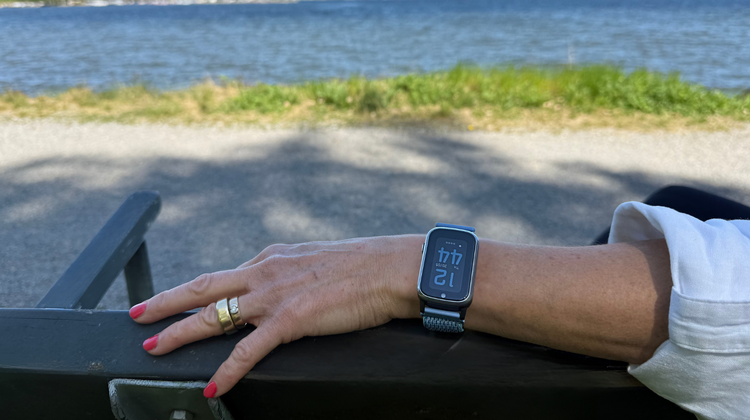
Sensorem’s personal alarm is designed for people with an increased risk of falling. It can be triggered manually or automatically if the person falls, and calls pre-set contacts with two-way voice communication through the watch’s built-in speaker. It works outdoors and has built-in GPS positioning, so you can always see where the person is in the Sensorem app.
READ ABOUT SENSOREM’S PERSONAL ALARM – SAFETY FOR THOSE AT INCREASED FALL RISK
More about hip fracture
Want to know more? Read more in our guides: Hip fracture in the elderly – risks and recovery – Hip fracture symptoms – Personal alarm after hip fracture
References
- [1] NHS. Hip fracture – overview, symptoms and treatment. https://www.nhs.uk/conditions/hip-fracture/