
What Is a Person with Vascular Dementia Like?
Vascular dementia affects every individual differently depending on which parts of the brain have been damaged. Personality, behaviour and cognitive abilities change gradually – but symptoms can vary from day to day and differ clearly from Alzheimer’s.
Vascular dementia affects every individual differently depending on which parts of the brain have been damaged and how severe the condition is. Personality, behaviour and cognitive abilities change gradually, but symptoms can vary from day to day. Here we explore what a person with vascular dementia may be like for themselves and those around them. Read also about the disease progression of vascular dementia for a broader picture.
Memory problems and mental sharpness
Unlike Alzheimer’s disease, where memory loss is often the first sign, a person with vascular dementia may have relatively preserved long-term memory. Short-term memory, however, can be affected, making it difficult to remember what was just said or what one was about to do. Planning, problem-solving and taking initiative can also be challenging.
The person may struggle to find words or express themselves coherently, which can cause frustration for both the individual and those around them.
Mood swings and emotional instability
Emotions can become less predictable. Many people with vascular dementia become easily irritated, sad or despondent. Depression and anxiety are common and can be reinforced by the awareness that abilities are declining.
Sudden emotional outbursts – such as laughing or crying without an obvious reason – are also common. This reflects reduced capacity in the brain to regulate emotions.
Reduced concentration and attention
A person with vascular dementia may have difficulty maintaining focus on conversations or activities for extended periods. It can seem as though they quickly lose the thread or are easily distracted.
In social settings this can be demanding, both for the individual and for those around them. Someone who was previously social and outgoing may withdraw because conversations and gatherings feel overwhelming.
Physical difficulties and coordination problems
Since vascular dementia is caused by disruptions in blood flow to the brain, the body’s motor function can also be affected. Depending on which brain areas are damaged, the person may experience balance problems, weakness on one side of the body, or an unsteady gait.
This can increase the risk of falls, and in some cases the person may begin to move more slowly and hesitantly than before.
Behavioural changes and lack of initiative
A clear change that many carers notice is that the person becomes more passive. Previous interests may no longer engage them in the same way, and it can be difficult to take initiative to do anything at all.
Repetitive behaviours – such as asking the same question or repeating the same action – may also increase. In some cases the person may develop suspiciousness, and in more advanced stages delusions can occur.
Social relationships and the carer’s role
The changes that occur with vascular dementia affect not only the individual but also those closest to them. Communication can become more difficult, and it can be emotionally challenging to see a loved one change.
Patience, understanding and adapting everyday life are important for creating a safe and manageable existence. Maintaining structure and finding adapted ways to spend time together can make a significant difference to how the person experiences their life.
Read more: Vascular dementia – Disease progression of vascular dementia – What is dementia? – Dementia tracker
Sensorem’s safety alarm has GPS positioning, medication reminders and automatic fall alarm
Sensorem’s personal alarm is an example of a technical aid specially developed for people with dementia. The personal alarm works outdoors and has built-in GPS positioning so that relatives can see the user’s position on a map in the Sensorem app. Relatives are automatically called by the personal alarm (two-way communication) if the user leaves a predetermined geographical area. The personal alarm also has medication reminders, which means that the watch emits a sound and tells the user that it is time to take their medication. The personal alarm can also alert automatically in the event of a fall with the built-in fall sensor.
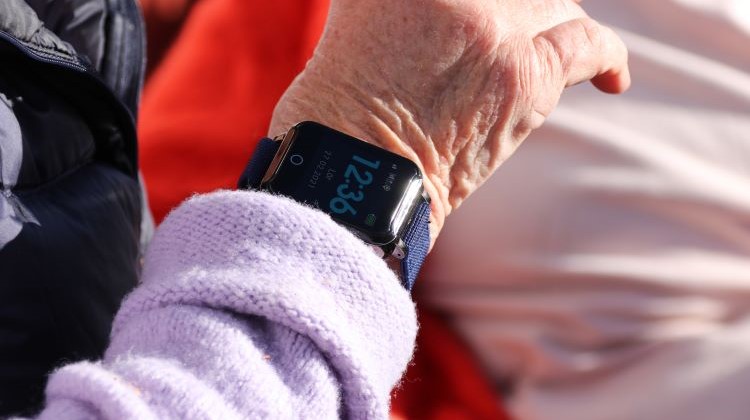
READ ABOUT HOW SENSOREMS PERSONAL ALARM CAN HELP WITH DEMENTIA
References
- [1] O’Brien JT, Thomas A. “Vascular dementia.” Lancet, 2015;386(10004):1698–1706. https://doi.org/10.1016/S0140-6736(15)00463-8
- [2] Alzheimer’s Society. Vascular dementia – symptoms. https://www.alzheimers.org.uk
- [3] NHS. Vascular dementia – symptoms. https://www.nhs.uk